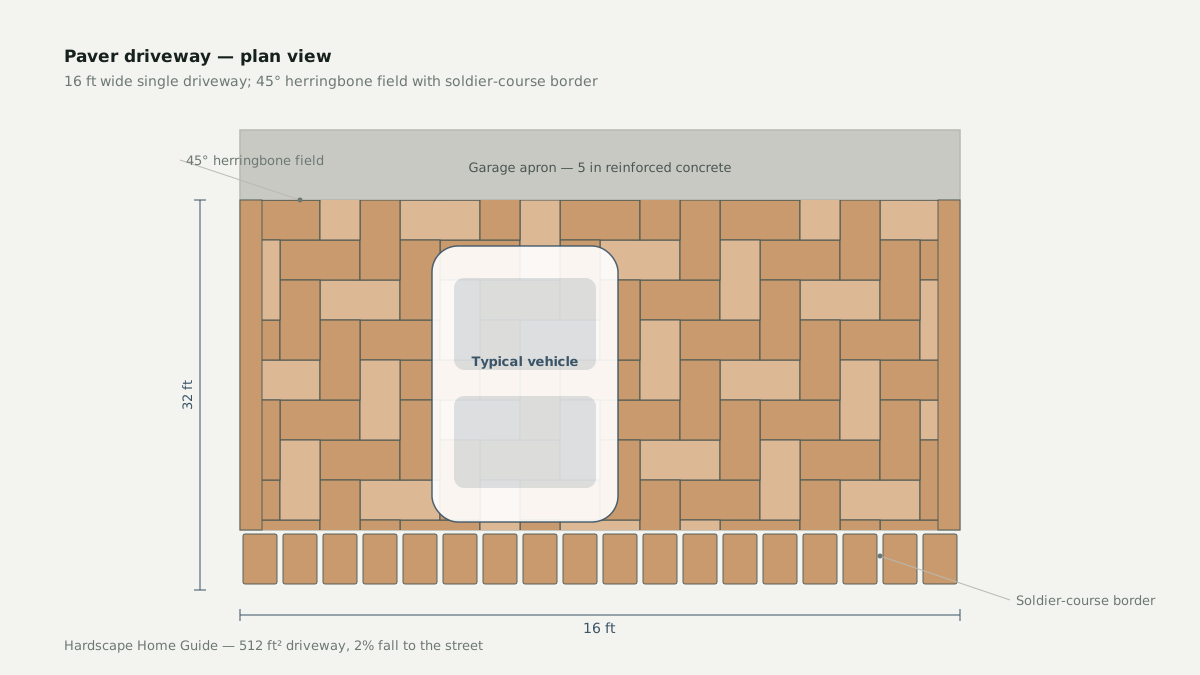
A paver driveway is the most expensive way to surface a driveway and the only one that can be lifted and relaid. Whether it is worth it comes down almost entirely to what is buried underneath.
Pavers do not carry a vehicle’s weight. They spread it. The base does the carrying, and a base that is too thin or was not compacted in lifts will fail regardless of how good the pavers are.
What it costs, per square foot
| Component | Typical range | Share of cost |
|---|---|---|
| Excavation and disposal | $1.50–$3.50/ft² | 15–20% |
| Base aggregate and compaction | $2.00–$4.00/ft² | 20–25% |
| Pavers (material) | $3.00–$8.00/ft² | 30–40% |
| Laying labour | $2.50–$5.00/ft² | 20–25% |
| Edge restraint and joint sand | $0.50–$1.50/ft² | 5–8% |
| Total installed | $8–$20/ft² |
A 500 ft² two-car driveway therefore runs about $4,000 to $10,000. Prices exclude drainage, retaining and any regrading of the surrounding ground.
In Canada, expect similar figures in Canadian dollars. In Australia and New Zealand, installed costs typically land 20–40% higher for the same specification.
The base is the driveway
This is the part that gets cut when a quote looks unusually cheap.
| Traffic | Base depth | Paver thickness |
|---|---|---|
| Pedestrian only | 4–6 in (100–150 mm) | 40–60 mm |
| Cars and light vans | 6–8 in (150–200 mm) | 60 mm |
| Occasional heavy vehicle | 8–10 in (200–250 mm) | 80 mm |
| Poor or clay subgrade | 10–12 in (250–300 mm) | 80 mm |
Depths are compacted thickness. Loose aggregate compacts by roughly 25%, so 8 in compacted means placing about 10–11 in loose.
Two details matter as much as the depth:
- Compaction in lifts. Base placed in one 10 in layer will not compact through its full depth. It goes down in 4 in lifts, each compacted before the next.
- Separation fabric. A geotextile between subgrade and base stops fine soil pumping upward into the aggregate, which is what turns a firm base into a spongy one over a few seasons.
Choosing a pattern
Pattern is a structural choice as much as a visual one, because it decides how the pavers interlock and where the cut waste falls.

| Pattern | Interlock | Cut waste | Best for |
|---|---|---|---|
| 45° herringbone | Two directions | ≈7% | Driveways, slopes |
| 90° herringbone | Two directions | ≈6% | Driveways |
| Running bond | One direction | ≈3% | Patios, paths |
| Basketweave | Moderate | ≈5% | Patios, accents |
| Stack bond | None | ≈2% | Not for driveways |
Stack bond is included for completeness only. With no interlock it is unsuitable for any surface carrying vehicles.
Where the driveway slopes, herringbone also resists the downward creep that affects running bond on gradients above about 5%.
Edge restraint and drainage
Pavers are held in place by joint sand friction and by a rigid edge. Without an edge restraint, the field spreads outward under repeated loading and the joints open at the perimeter first.
Restraint is either a concrete haunch, poured against the edge course, or a spiked plastic or aluminium edge. Concrete is stronger and standard for driveways; plastic edge is acceptable for paths and patios.
Drainage has to be designed, not left to chance. Aim for a 2% fall — about 1 in 4 ft — away from the garage and toward the street or a drainage point. Water that ponds on a driveway finds the joints, then the base, then the subgrade.
Where the water goes
- To the street — the simplest approach where local rules allow it.
- To a channel drain across the apron, in front of the garage door. Necessary where the driveway falls toward the building.
- To a permeable build-up — open-graded base with wider joints, letting water infiltrate. Requires a free-draining subgrade and is not suitable over clay.
- To a soakaway or dry well, where runoff to the street is restricted.
Maintenance that actually matters
A paver driveway needs very little, but the little it needs is not optional.
- Top up joint sand every 2–3 years, or after any pressure washing. Open joints are how pavers move.
- Do not pressure wash aggressively. It strips the joint sand that holds the field together. A garden hose and a stiff brush handle most staining.
- Deal with efflorescence early. The white bloom is soluble salts migrating to the surface. It usually weathers away; a proprietary efflorescence remover handles persistent cases.
- Lift and relay rather than patch. Localised sinking is a base problem. Filling the dip with sand hides it for one season.
Snow, salt and freeze-thaw
Pavers handle freeze-thaw better than a rigid slab because they move independently rather than cracking as one sheet. Two cautions in cold climates:
- Use de-icing salt sparingly. Sodium chloride attacks concrete and accelerates surface spalling. Sand or grit is kinder to the surface.
- Never chip ice off with a metal blade. A steel snow shovel edge lifts pavers and scars the surface. Use a plastic or rubber-edged blade.
In Australia and New Zealand the equivalent stress is heat and UV rather than frost. Lighter-coloured pavers stay markedly cooler underfoot, which matters on a driveway that faces the afternoon sun.
If you are comparing materials rather than committing to pavers, our guide to concrete patios covers slab thickness and jointing for a poured surface, and the paver pattern guide goes deeper on how pattern choice changes cost and waste.
Frequently asked questions
How much does a paver driveway cost per square foot?
Expect $8–$20 per square foot installed in the US, depending on paver type, pattern and site access. Herringbone and larger-format pavers sit at the upper end because of cutting and laying time, not material cost.
How deep should the base be under a paver driveway?
For cars, 6–8 in (150–200 mm) of compacted crushed aggregate in two lifts, over a compacted subgrade. For occasional heavy vehicles or poor subgrade, go to 10–12 in. Base depth is what carries the load; the paver only spreads it.
Which paver pattern is strongest for a driveway?
45° herringbone interlocks in two directions and resists tyre push best. Running bond is easier and cheaper to lay but shifts under repeated turning. Whatever the pattern, a soldier-course border and an edge restraint are what stop the field spreading.
Can pavers be laid over an existing concrete driveway?
Only if the slab is sound, well drained and has no reflective cracking history. Otherwise you are transferring every existing fault to the new surface. Removal and a proper base usually costs less than the failure.
Do paver driveways need sealing?
Not for structural reasons. Sealing slows efflorescence and colour fade and makes cleaning easier, but a sealed driveway still needs joint sand topped up. Reapply every 3–5 years if you seal at all.
