Belgard is one of the largest paver manufacturers in North America, and the name turns up in almost every driveway quote. It is worth being clear about what that does and does not tell you.
Belgard is a brand, not a specification. A quote that says “Belgard pavers” has told you the manufacturer and nothing about the unit, the base, or the standard of installation. Those are what decide whether the driveway lasts.
What the brand actually covers
Belgard’s range spans several product families, and they are not interchangeable. Broadly:
- Standard interlocking pavers — 60 mm units for patios, paths and residential driveways. The workhorse range.
- Driveway-grade units — 80 mm thick, for vehicle loading and turning.
- Textured and tumbled finishes — the same structural unit with a distressed face. Aesthetic premium, not a structural one.
- Large-format slabs — for contemporary designs, laid on a different base specification than small units.
- Retaining wall systems — a separate product family with its own engineering.
Within each family, what matters for performance is compressive strength, water absorption and thickness. Ask for those three numbers, not the brand name.
| Property | Target | Why it matters |
|---|---|---|
| Compressive strength | ≥ 8,000 psi (55 MPa) | Resists point loads |
| Water absorption | ≤ 5% | Freeze-thaw durability |
| Thickness (driveway) | 80 mm (3.1 in) | Load spreading |
| Thickness (patio) | 60 mm (2.4 in) | Adequate for foot traffic |
Figures follow the ASTM C936 and CSA A231 families of standards for solid concrete interlocking paving units. Ask to see the manufacturer’s current test data.
Pattern: where the money goes
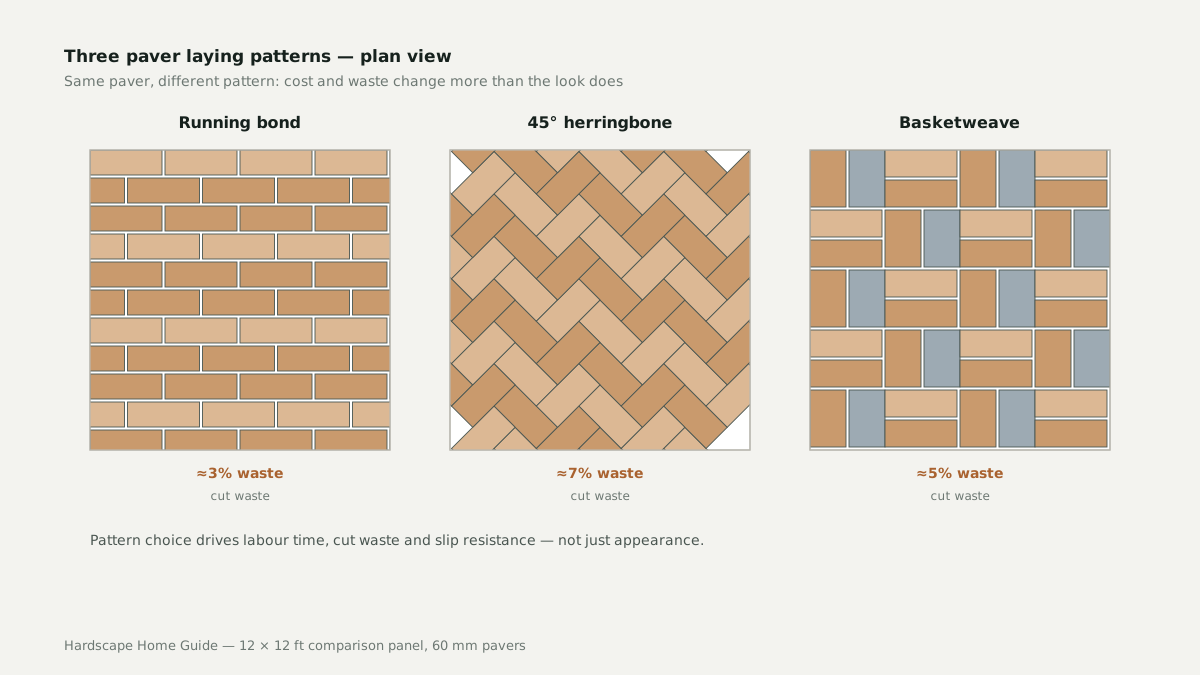
The single biggest controllable cost difference between two otherwise identical paver jobs is the laying pattern, because it changes both labour time and cut waste.

| Pattern | Cut waste | Laying labour | Relative cost |
|---|---|---|---|
| Running bond | ≈3% | Baseline | Baseline |
| Basketweave | ≈5% | +10% | +8–12% |
| 90° herringbone | ≈6% | +20% | +15–20% |
| 45° herringbone | ≈7% | +30% | +20–30% |
Waste is the extra material you must buy, not material thrown away. Offcuts at the perimeter are largely unusable in a diagonal pattern.
On a 500 ft² driveway, the difference between running bond and 45° herringbone is typically $700–$1,500. Herringbone earns that back on a driveway through better interlock under turning wheels. On a patio, it is purely an aesthetic decision.
Comparing quotes without being misled
Paver quotes vary by 300% for the same visible outcome, because they differ on the parts you cannot see. Ask every contractor for the same six numbers:
- Excavation depth — total depth removed, in inches.
- Base aggregate depth, and in how many compacted lifts.
- Compactor type — a plate compactor for base, or a vibratory roller on larger areas.
- Edge restraint type — concrete haunch or spiked edge, and whether it is included.
- Joint sand — polymeric or standard, and whether it is included.
- Waste allowance — the percentage of extra material they have priced.
Polymeric versus standard joint sand
| Type | Cost | Best for | Watch out for |
|---|---|---|---|
| Standard sand | Lowest | Sheltered patios | Washes out, needs topping up |
| Polymeric sand | 2–3× standard | Driveways, slopes | Poor installation hazes the surface |
| Resin jointing | Highest | High-traffic, permeable | Higher material cost |
Polymeric sand is activated with water and sets semi-rigid. It resists washout and ant mining well. It is unforgiving of a rushed install: residue left on the paver face sets hard and is very difficult to remove.
Repair and replacement
The practical advantage pavers have over concrete is that damage is local. A cracked or stained paver can be lifted with two screwdrivers and replaced in twenty minutes, provided you kept spares.
Keep 2–3% of the total order as spares, stored out of the sun. Dye lots vary between production runs, and a paver bought three years later will not match, even in the same colour name.
Lifting a paver without damaging it
- Remove the joint sand around the unit with a narrow scraper.
- Work two flat-blade screwdrivers or a paver extractor down opposite edges.
- Lift vertically and evenly. Levering from one side snaps the unit.
- Scrape and re-level the bedding sand before seating the replacement.
- Re-sand the joints and compact.
Where pavers are the wrong choice
Worth saying plainly: pavers are not always the answer. A poured concrete slab costs less and needs less base preparation. A stamped concrete surface delivers a similar look for 20–40% less on first cost. Pavers win where you want repairability, permeability, or movement tolerance on a site with poor or shifting subgrade — and where you are willing to pay for the base that makes them work.
Frequently asked questions
Is Belgard better than other paver brands?
Belgard is one of several large manufacturers with comparable engineered products. What matters more than the brand is the specific unit's compressive strength, absorption rate and thickness for your application, plus the installer's base preparation.
How much do Belgard pavers cost per square foot?
Material typically runs $3–$8 per square foot, and installed cost lands between $10 and $25 per square foot depending on pattern, site access and region. Premium textured and large-format lines sit at the top of that range.
Which Belgard laying pattern wastes the least material?
Running bond wastes least, around 3%. Basketweave runs about 5%, and 45° herringbone about 7% because of the diagonal cuts at every edge. Order the waste percentage as extra material rather than assuming it is included.
How do I compare two paver quotes fairly?
Ask both to itemise excavation, base aggregate depth, compaction method, edge restraint, joint sand and waste allowance. Quotes that look 30% apart are usually differing on base depth, which is the single most expensive thing to get wrong.
